Changing of the Guard London — The Five regiments of the king’s guard
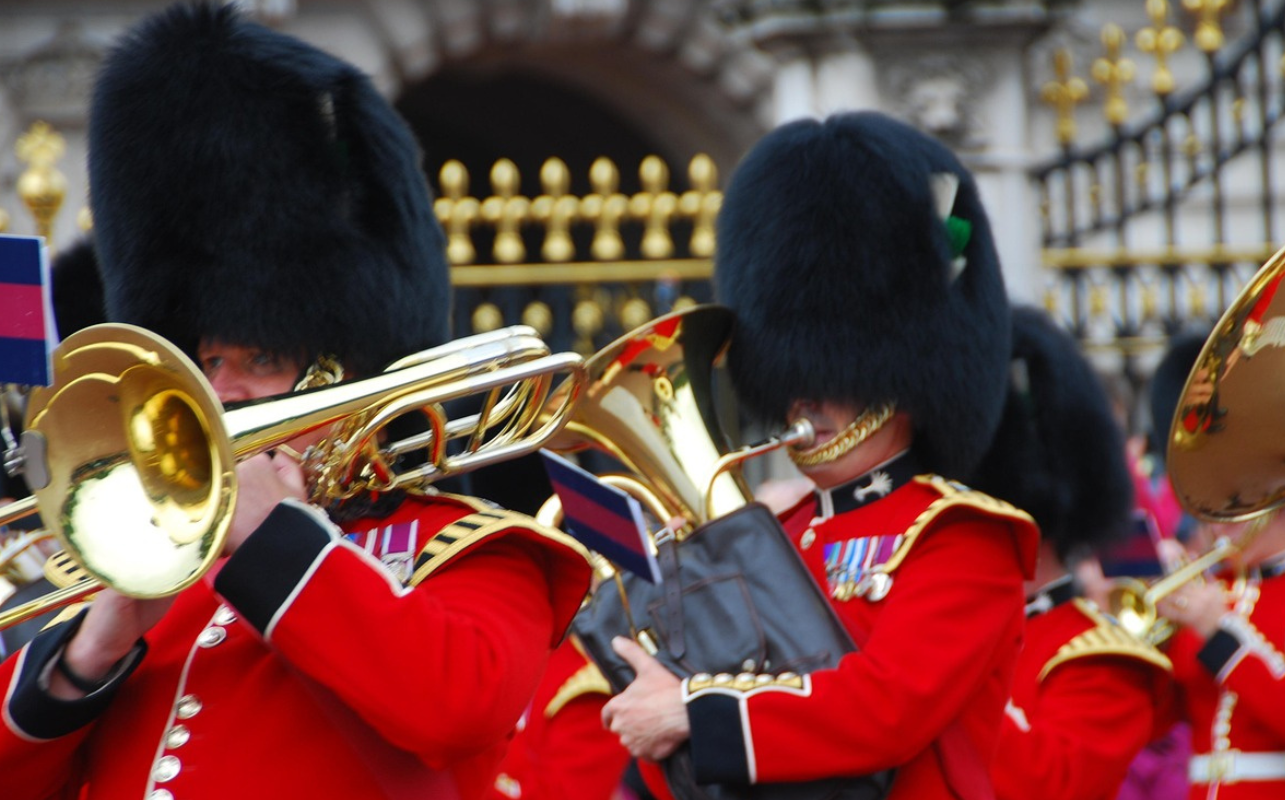
The Changing of the Guard ceremony at Buckingham Palace — officially known as Guard Mounting — is London's most-watched royal tradition, drawing millions of visitors each year. At the heart of the ceremony are the five Foot Guards regiments of the Household Division: the Grenadier Guards, Coldstream Guards, Scots Guards, Irish Guards and Welsh Guards. Every soldier on parade is a fully trained, battle-ready member of the British Army — ceremonial duty is a secondary role for combat veterans who have served in Afghanistan, Iraq and beyond.
The ceremony marks the formal handover of responsibility for protecting the Sovereign between the Old Guard (currently on duty) and the New Guard (arriving from Wellington Barracks, accompanied by a regimental band). It takes place on the forecourt of Buckingham Palace and spans approximately 45 minutes. Entry is completely free — no tickets or booking required.
Each regiment wears the same iconic scarlet tunic and black bearskin cap, but carries distinctive identification marks in the plume colour and position on their bearskin, and the pattern of buttons on their tunic. Read each regiment's full story to become a true expert before you visit.
The Grenadier Guards
"Honi soit qui mal y pense" — Shame on him who thinks evil of it
How to identify at the Changing of the Guard
Plume: White, worn on the left side of the bearskin
Buttons: Spaced singly (evenly apart) down the tunic
Collar badge: Grenade fired proper
When you watch the Changing of the Guard at Buckingham Palace, the regiment most likely to be providing the King's Guard is the Grenadier Guards — the most senior infantry regiment in the entire British Army. Formally titled "The 1st or Grenadier Regiment of Foot Guards," their lineage traces to 1656, when Lord Wentworth's Regiment was raised in Bruges, Belgium, to protect the exiled King Charles II. Look for the distinctive white horsehair plume worn on the left side of their towering black bearskin cap, and buttons spaced singly down the front of their scarlet tunic — the easiest way to spot the regiment instantly in the forecourt of Buckingham Palace.
The Grenadier Guards earned their famous name after the Battle of Waterloo in 1815. Following the defeat of Napoleon's Imperial Guard — Europe's most feared grenadiers — King George III granted the regiment the right to wear a grenadier cap and adopt the title "Grenadier Guards" in recognition of their role in that decisive victory. It remains one of the proudest distinctions in British military history.
As an operational combat regiment, the Grenadiers have fought in every major British conflict since the 17th century, from the Siege of Gibraltar and the Peninsular War to the Somme, Dunkirk, North Africa, and the Falklands. The regiment also provided the founding cadre for both the Irish Guards (1900) and the Welsh Guards (1915). King Charles III holds the position of Colonel-in-Chief, continuing a royal association that stretches back to the regiment's founding.
At the Changing of the Guard ceremony, the Grenadiers parade on the extreme right of the line. Their King's Company — composed entirely of soldiers standing at least six feet tall — provides some of the most impressive ceremonial soldiers in the world. Every Guardsman you see in the forecourt of Buckingham Palace is a fully trained combat soldier, with the regiment maintaining active deployment capability alongside its prestigious ceremonial role at the Royal Palace.
The Coldstream Guards
"Nulli Secundus" — Second to None
How to identify at the Changing of the Guard
Plume: Red, worn on the right side of the bearskin
Buttons: Spaced in pairs down the tunic
Collar badge: Star of the Garter
Spot the Coldstream Guards at the Changing of the Guard ceremony by their vivid red plume on the right side of the bearskin cap and buttons arranged in pairs down the scarlet tunic. The Coldstream Guards are officially the oldest regiment in the British Army in continuous active service — founded on 13 August 1650 by General George Monck, who raised them from veteran Parliamentary regiments during the English Civil War. Their defiant motto, Nulli Secundus (Second to None), is a direct riposte to their position second in the order of precedence behind the Grenadier Guards — a ranking they have never accepted, since they are the older regiment.
The regiment takes its name from the Scottish border village of Coldstream, from which General Monck marched his troops to London in January 1660 to restore the monarchy and crown King Charles II. It was this act of loyalty that secured the regiment's survival — and its place at the heart of British royal life ever since. When on parade alongside the other Foot Guards at Buckingham Palace, the Coldstream always stand on the extreme left of the line, a position held with the same pride as the Grenadiers hold the right.
The Coldstream Guards have accumulated some of the most distinguished battle honours in the British Army, including Waterloo, the Crimea, Egypt, the Boer War, the Somme, Dunkirk, and operations in the Falkland Islands. Their nickname, the Lilywhites, is said to derive from early white uniform facings. Today, the regiment continues to alternate between operational deployments and the prestigious ceremonial duty of providing the King's Guard at Buckingham Palace — a duty that has continued without interruption since 1660, the longest unbroken royal guard in history.
The Scots Guards
"Nemo me impune lacessit" — No one provokes me with impunity
How to identify at the Changing of the Guard
Plume: None — the Scots Guards are the only regiment with a bare bearskin cap
Buttons: Spaced in groups of three
Collar badge: The thistle
The easiest regiment to identify at the Changing of the Guard at Buckingham Palace is arguably the Scots Guards — because they are the only regiment who wear no plume at all on their bearskin cap. Their three-century-old tradition of wearing a bare cap stems from their position at the centre of the line when all five Foot Guards parade together: the plume marks the flanks; the centre has no need of one. Their second identifier is equally unmistakable — buttons arranged in groups of three down the scarlet tunic. Their thistle collar badge reflects their proud Scottish heritage.
The Scots Guards trace their origins to 1642, when King Charles I ordered the regiment raised by Archibald Campbell, 1st Marquess of Argyll, as the personal royal bodyguard of the Scottish Crown. It joined the English establishment in 1686, becoming the third regiment of Foot Guards. Their formidable battle honours span three centuries: the War of the Spanish Succession, the Peninsular War, Waterloo, the Crimea (where they helped form the celebrated Thin Red Line at the Battle of Balaclava), the Boer War, both World Wars, the Falklands, Northern Ireland, Iraq and Afghanistan.
Among their most celebrated modern battle honours is the Falklands War of 1982, where the 1st Battalion Scots Guards fought at the Battle of Mount Tumbledown — one of the fiercest engagements of the conflict. That same regiment returned to provide the King's Guard at Buckingham Palace within months, exemplifying the unique dual nature of all five Foot Guards: elite combat soldiers who perform the world's most famous ceremonial duty. HRH The Duke of Edinburgh serves as the regimental Colonel.
The Irish Guards
"Quis Separabit" — Who shall separate us?
How to identify at the Changing of the Guard
Plume: Blue, worn on the right side of the bearskin
Buttons: Spaced in groups of four
Collar badge: The shamrock
Look for the distinctive blue plume on the right side of the bearskin and buttons in groups of four to identify the Irish Guards at the Changing of the Guard at Buckingham Palace. Their shamrock collar badge is equally unmistakable — and on St Patrick's Day each year, the regiment receives a ceremonial sprig of shamrock from a member of the Royal Family, a tradition begun by Queen Alexandra in 1901 and continued to this day. The Irish Guards are one of the newest of the five Foot Guards regiments, founded on 1 April 1900 by Queen Victoria to honour the extraordinary bravery of Irish soldiers during the Second Boer War in South Africa.
Affectionately known as "The Micks," the Irish Guards built an immediate and distinguished record from the moment of their formation. In the First World War, the regiment suffered devastating casualties on the Western Front, including the death of John Kipling — son of the poet Rudyard Kipling, who went on to write the regiment's official history, The Irish Guards in the Great War, as a memorial to his son. The regiment served with equal distinction in the Second World War, fighting in North Africa, Italy and North-West Europe as part of the Guards Armoured Division.
The Irish Guards also have a beloved regimental mascot: an Irish Wolfhound, one of the largest dog breeds in the world, who marches at the head of the regiment on ceremonial occasions. When the Irish Guards take their turn providing the King's Guard at Buckingham Palace, their wolfhound mascot — currently named Seamus — will sometimes accompany the regiment on parade, making them one of the most photographed regiments in the entire Changing of the Guard ceremony. If you are visiting London and want to maximise your chances of seeing the Irish Guards on duty, check the confirmed Household Division schedule before your visit.
The Welsh Guards
"Cymru am byth" — Wales for ever
How to identify at the Changing of the Guard
Plume: White-green-white (tricolour), worn on the left side
Buttons: Spaced in groups of five
Collar badge: The leek (Welsh national emblem)
Identify the Welsh Guards at the Changing of the Guard ceremony at Buckingham Palace by their unique tricolour plume — white, green and white — worn on the left side of the bearskin, reflecting the colours of the Welsh flag. Their buttons in groups of five make them the easiest regiment to count, and their leek collar badge, the national emblem of Wales, confirms the identification instantly. The Welsh Guards are the youngest of the five Foot Guards regiments, founded by Royal Warrant of King George V on 26 February 1915 to ensure Wales was fully represented among the Household Division.
Their history is remarkably swift and distinguished. Just three days after the regiment's formation, the 1st Battalion Welsh Guards mounted its first King's Guard at Buckingham Palace on 1 March 1915 — St David's Day, the patron saint of Wales, making it one of the most auspicious regimental debuts in British Army history. By August 1915, the regiment was deployed to France, entering the Battle of Loos in September. In the century since, the Welsh Guards have served in both World Wars, Palestine, Aden, Northern Ireland and the Falkland Islands, where they suffered significant casualties at Bluff Cove in 1982, before returning to ceremonial duties at Buckingham Palace — a testament to the regiment's resilience and commitment.
King Charles III is the Colonel-in-Chief of the Welsh Guards, and the regiment has a particularly close connection to the Prince of Wales title and investiture ceremonies. In the 21st century, the regiment has deployed to Bosnia, Iraq and Afghanistan, winning the Orwell Prize-winning account Dead Men Risen about their 2009 Helmand campaign. When you see the Welsh Guards providing the King's Guard at Buckingham Palace — their five-button tunics gleaming in the London light — you are watching soldiers who serve with the same extraordinary dedication in peace as in war.