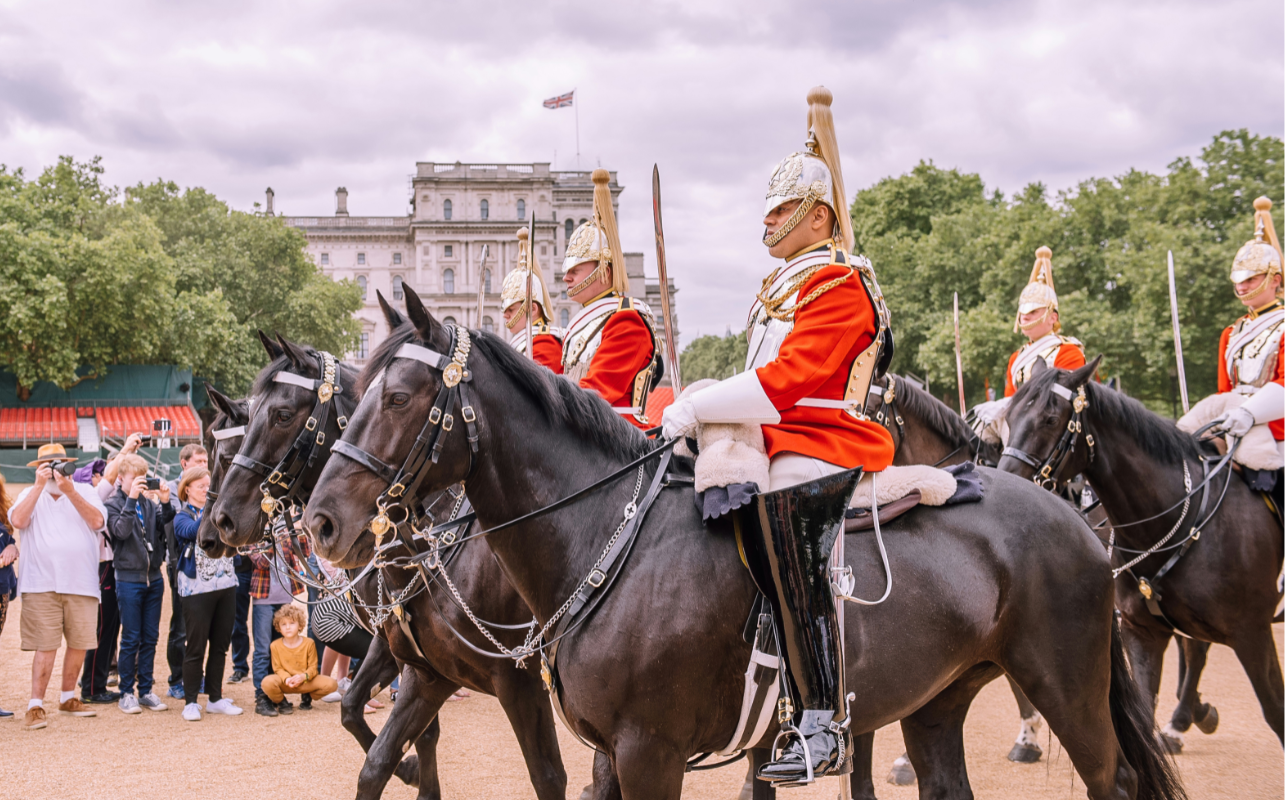
The Household Cavalry — The King's Mounted Bodyguard at the Changing of the Guard
Who Are the Household Cavalry?
When you watch the Changing of the Guard at Buckingham Palace, the soldiers you see marching in red tunics and bearskin caps are the Foot Guards of the Household Division. But there is a second, equally historic element to the full royal guard ceremony in London — one that most visitors to Buckingham Palace never anticipate: the thunder of hooves on The Mall as the Household Cavalry ride past in full ceremonial uniform.
The Household Cavalry is a union of the two most senior regiments in the British Army: The Life Guards and The Blues and Royals (Royal Horse Guards and 1st Dragoons). Together with the five regiments of Foot Guards, they form the seven regiments of the Household Division — the elite corps responsible for protecting the sovereign and conducting the great state ceremonies of the British monarchy.
The Household Cavalry is part of the Household Division and, since 1660, its soldiers have acted as the monarch's personal bodyguard.
The Household Cavalry Mounted Regiment — The Ceremonial Face of the Household Cavalry
The Household Cavalry Mounted Regiment (HCMR) is the unit you will see during the Changing of the Guard and at major royal ceremonies throughout the year. Based at Hyde Park Barracks, Knightsbridge — where the regiment has been garrisoned since 1795 — the HCMR conducts mounted state and public duties in London, representing the Monarch and the Nation. As the Sovereign's bodyguard and part of the Household Division, the HCMR mounts a daily guard — called the King's Life Guard — at Horse Guards, which is the historical and ceremonial entrance to Buckingham Palace. This ceremony can be viewed daily by members of the public. Every day, whatever the season or weather, members of the Household Cavalry Mounted Regiment stand guard at Horse Guards, Whitehall. The Guard changes three times a week — Monday, Wednesday and Friday — with the regiment riding down from Hyde Park Barracks in Knightsbridge to take over guard duties at 11:00am.
How to tell the two regiments apart at the Changing of the Guard:
The Life Guards wear red tunics and white-plumed helmets.
The Blues and Royals wear blue tunics and red-plumed helmets.
Both regiments wear the iconic leather thigh-high riding jackboots and carry drawn swords when on mounted duty.
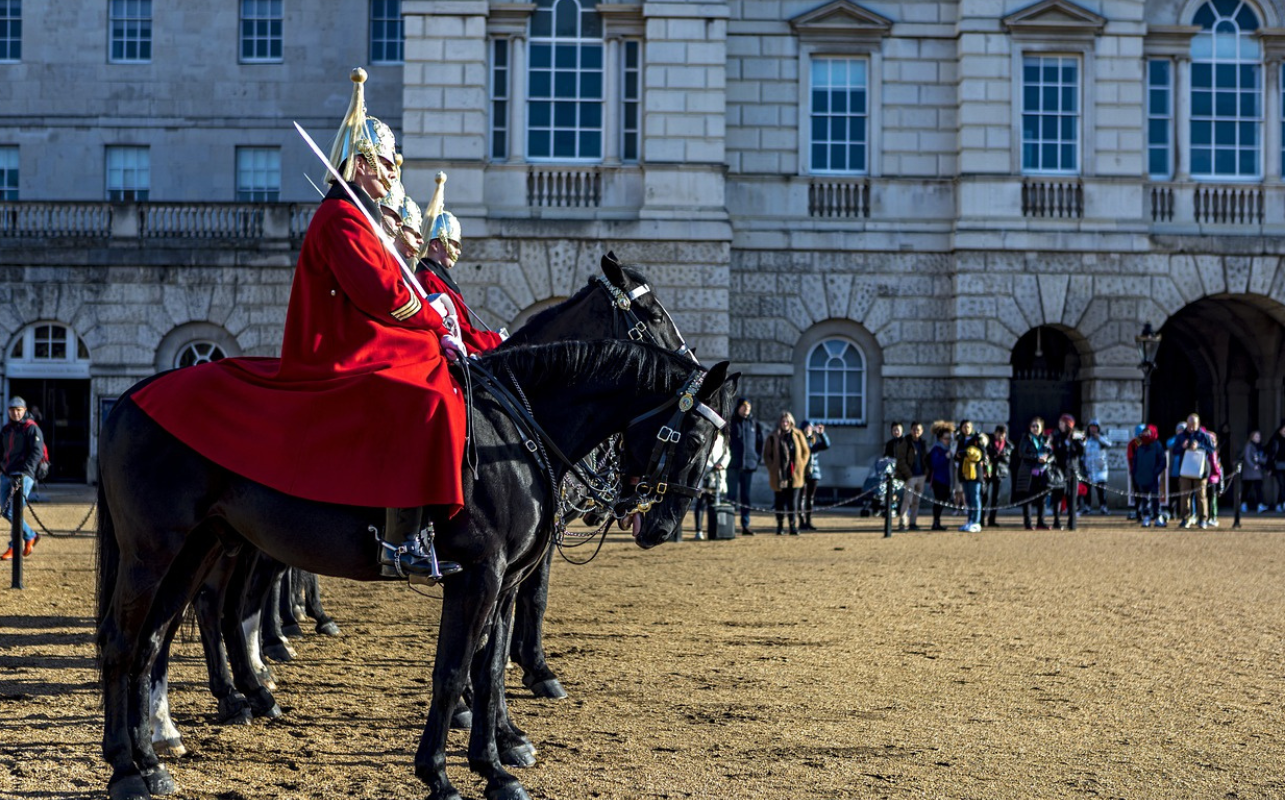
The King's Life Guard — London's Daily Mounted Ceremony
The King's Life Guard at Horse Guards Parade, Whitehall is one of London's most accessible and undervisited royal ceremonies — and it takes place every single day.
Horse Guards is named after the troops who have mounted the King's Life Guard here since the Restoration of King Charles II in 1660. The ceremony has remained mostly unchanged for over 350 years.
The ceremony of changing the King's Life Guard starts at 11:00am, with the Old Guard formed up on Horse Guards Parade. As the New Guard arrives, a trumpeter sounds a royal salute and the officer salutes. The New Guard forms up facing the Old Guard. Once both lines are still, the Corporal Major, senior NCO, and sentries of the New Guard rein back their horses and leave for the Guard Room to take over their duties, which last for 48 hours.
Horse Guards is the official main entrance to both St. James's Palace and Buckingham Palace. The guard is on horseback from 10:00am until 4:00pm, with the two sentries changing every hour. From 4:00pm until 8:00pm, a pair of dismounted sentries remain on duty. At 8:00pm, the gates of Horse Guards are locked and a single sentry remains until 7:00am.
When The King is in London: The Guard consists of one Officer, one Corporal Major (who carries the Standard), two Non-Commissioned Officers, one Trumpeter, and six Troopers. This full formation is known as a Long Guard.
Visitor Tip: The King's Life Guard at Horse Guards is significantly less crowded than the Changing of the Guard at Buckingham Palace and offers an exceptionally close view of the Household Cavalry, their horses, and their ceremonial uniform. It is one of the best free things to do in London that most visitors miss entirely.
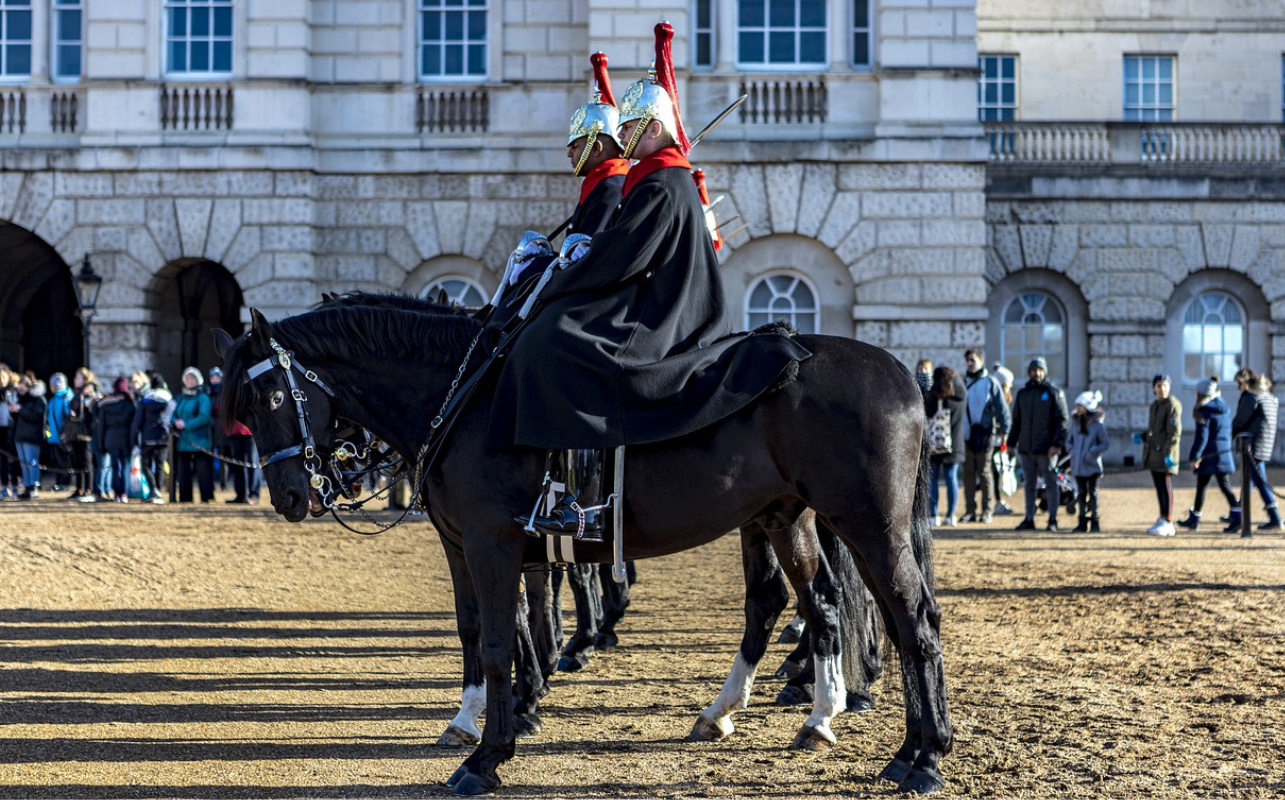
The Household Cavalry at the Changing of the Guard — What to Watch For
During the Changing of the Guard ceremony at Buckingham Palace, the Household Cavalry make a dramatic appearance. When The King is in residence at Buckingham Palace, the Foot Guards on the Palace forecourt will Present Arms — saluting with their rifles — as the King's Life Guard rides past on their return journey between the Queen Victoria Memorial and Buckingham Palace.
At approximately 11:37am, the Household Cavalry can be seen riding back down The Mall towards Horse Guards Parade — one of the most visually spectacular moments of the entire royal guard ceremony that the crowds at the Palace gates often miss.
Expert Tip: Position yourself on The Mall between approximately 11:30am and 11:40am and you will see both the Household Cavalry on horseback riding past and — at approximately 11:45am — the St. James's Palace detachment of The King's Guard marching back up The Mall led by their Regimental Band.
The Household Cavalry Regiment — Elite Soldiers on the Battlefield
Away from the ceremonial streets of London, the Household Cavalry Regiment (HCR) operates as a front-line British Army combat unit. The HCR provides an armoured reconnaissance capability. Soldiers are first and foremost reconnaissance experts but also hold other specialist abilities, including snipers, anti-tank weapon specialists, drone operators, and intelligence gatherers. As an armoured reconnaissance regiment, the Household Cavalry operates far ahead of the main body of friendly forces — locating, tracking, and reporting on enemy movements, and engaging enemy reconnaissance elements attempting to do the same. They are currently equipped with the British Army's state-of-the-art Ajax armoured fighting vehicle. The same regiment that rides in polished ceremonial uniform past Buckingham Palace is also among the most operationally experienced cavalry units in the British Army — deployed in conflicts across the world since their formation at the Restoration of Charles II.
Becoming a Mounted Dutyman — The Training Behind the Ceremony
The extraordinary horsemanship on display during the Changing of the Guard and at state ceremonies does not come naturally to most Household Cavalry recruits. Almost all recruits to the Household Cavalry Mounted Regiment have never ridden a horse before.
New soldiers begin Phase 2 training with a 12-week riding course at the Household Cavalry Training Wing in Combermere Barracks, Windsor, where they learn the basics of military equitation and horse welfare — riding, stable management, horse care, and equipment husbandry — all taught in detail. These 12 weeks are followed by a 4-week Kit Ride at Knightsbridge Barracks, where recruits are trained to clean and maintain their ceremonial equipment and ride in full ceremonial uniform.
On qualifying as a Mounted Dutyman, soldiers join the King's Life Guard rotation and take their place on parade as the sovereign's official mounted bodyguard — representing the Crown at Trooping the Colour (The King's Birthday Parade), the State Opening of Parliament, state visits by foreign heads of state, royal weddings, jubilee parades, and the daily King's Life Guard at Horse Guards.
The soldiers and horses remain at Horse Guards for 24 hours, standing guard in shifts throughout — with the horses retiring at 4:00pm while the men remain on duty on foot until morning.